Sunday, 10 May 2020

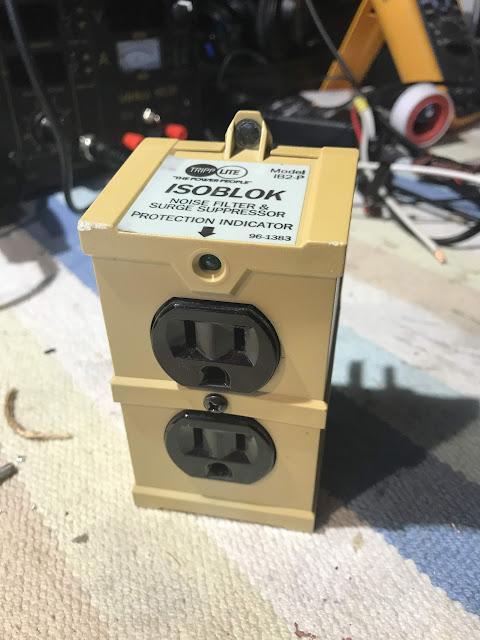
Tripp-Lite IB2-P

Tripp-Lite

What DOES this gadget do?  I have had it around for decades, likely 30 years.  Tonight I thought I would connect it up to the Siglent VNA and have a look at the frequency response.  I hope it has an attenuation of the HF bands as my testing about signal levels and grounding in the office/ham shack showed substantial RF emanating from the mains wiring.  I am hoping this device will "mute" some of the RF roaming around the office when I transmit.  


The test jig is simple.  Feed the signal from Port 1 on the VNA.  Connect the signal to ONE lead at a time on the Tripp-Lite referenced to the ground lug  and test the pass through characteristics.  First the "hot" lead side.

The usual precautions and setup were taken with the VNA and the test leads were used when the device was Pass Through Calibrated.  

The HOT leads first:  
RF Source connected to the PLUG side hot to Ground.  
RF Sence connected to the RECEPTACLE side, Neutral.


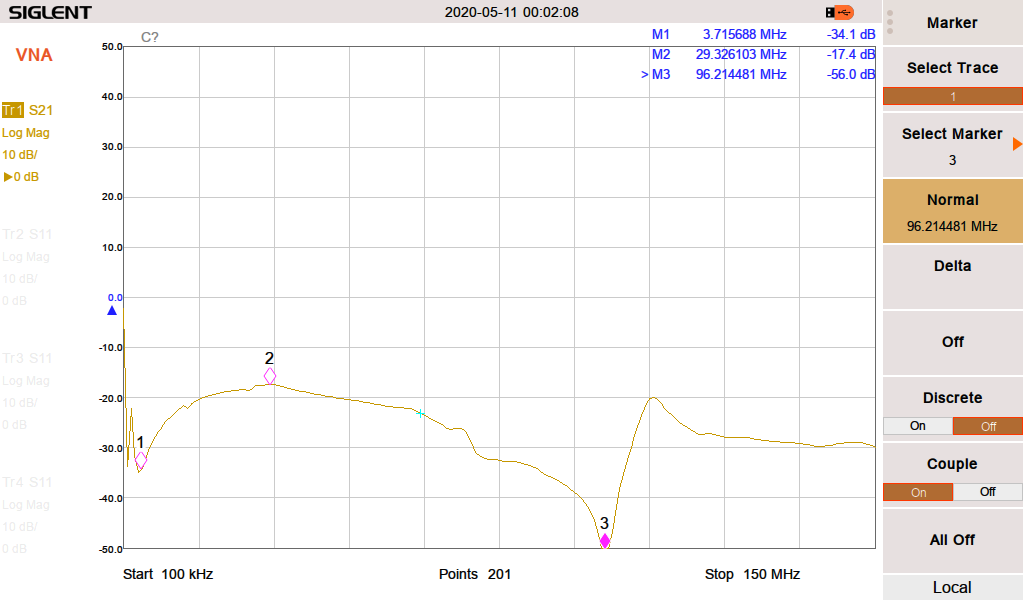
The sweep is from 100khz to 30 mHz.  More than 30db attenuation at roughtly 3 mHz, and increasing to 20 dB of attenuation at 30 mHz.  

Just out of curiosity, here is the sweep up to 150 mhz.  Always more than 20db of attenuation.  

The next thing to test is the NEUTRAL side of the device.  
RF Source connected to the NEUTRAL PLUG.  
RF Sense connected to the NEUTRAL RECEPTACLE


Summation:

It looks like this would provide at least 20 db across the amateur radio HF and VHF spectrum.  

So I am going to install it BEFORE the big power bar under the bench.  


Friday, 24 April 2020

Directional Coupler

Directional Coupler


It is embarrassing to admit that I have not built a directional coupler until this week.  I built one yesterday and the results were so interesting, I built a "better" one today.

Through what seems as much magic as anything else, a wire grounded at one end, and laying parallel another conductor with RF "on" it will have a sympathetic signal generated by the wave fronts travelling from the grounded end to the sensing end.  Not so much the other way around.  Every ham knows of Forward and Reverse readings on an SWR meter.  This is the same effect.

Insert diagram here.


My first attempt was with a 1/2" copper pipe and some connectors, and #14 magnet wire.  It worked well enough but the UHF connectors distorted due to the heat of sweating them onto the pipe and I could not get connectors in them.  Plan B

Hunting around for a suitable box, I found the one pictures below.  Much roomier than the 1/2" pipe.  An RF precision 50-ohm termination is at the right-hand end of the sensing element.


Connecting the Tracking generator output to Signal, a test antenna to Load and Port 2 of the VNA to the Reverse Sense port gave the following results.  When testing an antenna, less reflection at a frequency is better.  Sweeping through a range of frequencies "paints" a picture of what frequencies the antenna is most effective at and what frequencies it is not effective on. 


The sweep following is of the Rubber Duckie antenna pictured above.  It appear resonant from 125 through to 174 mHz.


My multiband fan dipole on the roof of the house is another matter entirely, with multiple resonances

more or less lining up with the ham bands.  Some better than others.  It looks as if I could spend another day on the roof fine tuning it.  Mind, you change one element and the whole thing shifts.  I see why it is so good at 3.573, the FT8 frequency, and so lousy at 3.733 mHz, the chat net I try and check into some evenings.  All in all the Directional Coupler appears to be a use

Wednesday, 22 April 2020

Daiwa Power Supply Repair and Thermistor Installation

Return of the humble Thermistor.


Repairing a Daiwa 30 ampere DC power supply.

2020 April 20

The journey starts out with the Daiwa power supply I purchased from VE3QX a few years ago popping the fuse the other morning.  I wasn't surprised as the lights always dimmed when I turned it on and sometimes you could hear a loud snap as the power switch contacts closed.  Rated at 30 amperes, there is a nasty back-EMF to the hefty transformer when powering it up.

I tried another fuse, just in case.  The lights dimmed and the fuse popped again. Okay, there is something wrong.

It did not take long to narrow it down to the bridge rectifier.  A dead short across all four contacts.  It is as if they were each welded together.


It is a KBPC3502G,  rated at 35 amperes, reverse voltage limit of 120V.  As the power supply is rated at 30 amperes @ 13.8 volts, this seems a little light for the application.  So I went looking in DigiKey.  The KBPC5010 looked like an admirable replacement for only $4.65 each.  50 amperes, 1.4KV reverse voltage on the diodes.
You can read all about it at:  https://html.alldatasheet.com/html-pdf/34010/WTE/KBPC5010/47/1/KBPC5010.html if you feel inclined.

It was a bit of a struggle getting it out, and the new one in as all connections were push-on connectors that were soldered in place.

Before I finalized the connections, I fed the voltage regulator circuit with another variable power supply and thankfully, there were no other problems.  Nice.  I kind of expected the regulator circuit to be fried as well!

As is my habit with high power anything, I like to "ease-up" the input voltage the first time and did so without connecting the primary winding to the rectifier first.  My 100-watt Variac was perfect for the job, and I monitored the output voltage of the transformer as well as input current.  All went well.  This step ruled out shorted windings or some other catastrophic failure in the transformer.


All connections were finished up, and the variac was used again to power it up.


Here it is working just fine.  The Daiwa is back in the rack powering my Icom 7300.  It is a very stately power supply, isn't it?  The Gothic design versus the Frank Lloyd-Wright design so common today with power supply faces.

But the story is not over!!

I got to thinking that this power supply worked for 25 years before the rectifiers failed.  Countless ON-OFF cycles.  So what may have caused this?  I could only think that an overcurrent or voltage would have had to have occurred for the diodes to fail into a shorted condition.  The first thing to do was to measure the inrush current.  I have a harness with ten turns of the "hot" wire between a plug and receptacle.  I rummaged around for my old Fluke 41B electrical meter.  It can measure these things.  But it turned out not be be "quick" enough to catch the spike of current.  Then I turned to my Fluke 189 II meter.  Turns out it has MIN MAX readings that are in the microsecond level  Perfect.  I connected the probe from the 41B to the input of the Fluke and measured MIN MAX AC Volts.  The probe generates 1mv of AC RMS per Ampere of current.  My ten times coil made it a little easier to measure, as it increased the coupling ten fold. After a dozen or so on-off cycles I measure 36.5 amperes (RMS) on one event.  A good starting point.

Then I remembered working on old television sets and hearing the dull thud of the degaussing coil.  Didn't they use Thermistors to limit the current?  Yes, that is true, and it looked something like this:


Thermistors come in two varieties, Negative Temperature Coefficient, meaning less current as they heat up, and Positive Temperature Coefficient, meaning the resistance drops as they heat up.  Degauss coils had both, one is series, the other in parallel.  You can read all about them at:

https://www.ametherm.com/blog/inrush-current/what-is-an-inrush-current-limiter-the-single-part-solution/

There is a curious connection to the invention of alkaline Duracells.

Automatic Degaussing (ADG) Circuit - study Material ...
It is a little different, but you can see that the thermistor is a PTC version, so the resistance DROPS as it heats up, but the Varistor (sometimes an NTC thermistor was used here) worked in the reverse method, Increasing in resistance as it warmed up.

So, I looked around the web and found Ameretherm and sent a message asking for guidance on choosing the correct Thermistor to help ease the startup current on the Daiwa power supply.

Here is the response from my message to Ameretherm:

Hello David,
Tony is on vacation so I am filling in for him.
Given:
Input voltage = 126V
Output power = 13.8V x 30A ≈ 414 Watt
Max allowable inrush current on primary = fuse rating = 8.0A
Inrush current measured = 35A
Assumption:
The Duration of inrush current = one cycle of 50Hz = 20 Milliseconds.
Calculations:
Energy the thermistor needs to handle repeatedly = Instantaneous Power x duration of inrush, Instantaneous Power = Inrush current x peak input voltage = 35Ax ( 126Vx 1.414) ≈ 6240 Watts
energy = 0.02  sec x 6240 Joules / sec ≈ 125Joules.
Steady-state = output power ÷ input voltage =  414Watt ÷ 126VAC ≈ 3.30Amp
Minimum Resistance = Peak voltage ÷ fuse rating = 126VAC x 1.414 ÷ 8.0A = 22.2 Ω
Selection:
I believe MS22 20005 is a good fit for you, would you like samples?

Mehdi Samii
VP Engineering & Sales
p:
(800) 808-2434
f:
(775) 884-0670
a:
961 Fairview Drive, Carson City, Nevada
w:

So I ordered some samples.

It didn't take long after reading this to wonder what the current curve looked like, so I hooked up my OWON "baby scope"  (compared to the old Tektronix TDS754 behemoth on the bench) with the Fluke current clamp and set the single shot trigger and proceeded to turn the PS on and off.  After a dozen or so tries this waveform was captured:


The CURRENT is 500 millivolts divide by 10 for the number of winds, yields peak current of just under 50 amperes, for roughly 2 milliseconds.  The whole spike is roughly 8 msec long.  Mehdi's calculations assume a longer duration of the current spike, likely for a worst-case, and it appears the choice of the Thermistor will be just fine.  This value corresponds nicely with the Fluke 189 II RMS MAX reading of 36.5 Volts.

My next entry will be AFTER the thermistor is installed.  it will be interesting to see the difference.

David Balcaen, VE2GYA.  2020-April 20

73 and good dx

2020 May 4

Despite the Covid-19 pandemic, the UPS truck and driver delivered my samples from Ameretherm.  It did not take long to pull a tie strip out of my parts drawers and install the Thermistor in the mains lead.  I seem to recall they were always mounted out in the clear in case they exploded or got really hot.  A through-bolt on the transformer was quite handy:


The placement could not be simpler, place in the mains supply lead, either leg.  For all intents and purposes, the resistance at running current is negligible.

But does it make a difference?


20 mv per division.  Peak to Peak, 6 divisions, for 120 mv.  And as this is connected to a X10 multiplier for the current rating we divide by 10 for a 12 mv peak.   As the probe yields 1mv per Ampere, we have a peak measured current of 12 amperes.


So was it worth the time and effort?

You bet!  Inrush current is ONE FOURTH what it was without the Thermistor.  The power supply has lost the familiar "THUD" when powered up.  Simply, inrush current is REDUCED.


I declare the experiment a Success!!

Every Daiwa 30A power supply ought to have one installed.

Here is the detail about the MS22 2005 thermistor I used. 

Saturday, 28 March 2020

Coaxial Cable Choke Experiment

Because everyone wants results without the work or time, here they are.  The attenuation graph of the OUTER SHIELD from one end of the cable with coils to the other.  One coil is six turns at 5.25 inches diameter, the second coil 3 turn, same diameter.  The graph above shows that there is between 10 db to 20 db attenuation from 80 meters all the way up to 6m where the data ends.  The little ferrites are meant for VHF and above, so they only add a very little bit to the upper end of the frequency response.

Finished two coil choke:
This is an image of the testing setup. Notice the leads soldered onto the SHIELD of the connectors at both ends of the cable. The test device is a Siglent SVA1015X. 

Now, the work that went into it: The purpose of this experiment is to see if it is possible to measure the RF LOSS of coaxial cable chokes, and to investigate them a little bit. The theory is that winding up a coil of coaxial cable "chokes" off RF currents on the outside of the sheath due to the inductance impedance of the coil of wire.  Let's see what we can measure.

Why am I doing this? 

When I transmit full power on digital modes on the 30 metre band, the furnace fan cycles on and off.  Obviously I have RF on the outside of the coaxial cable and it runs right beside the furnace. So I did some reading and scrounged around for some cable.  Here is my attempt. The method is to take a 16 foot length of RG8X I had handy and try a couple of different chokes, and some ferrites I had on hand.

Method:

Is to connect the OUTER connection of the coaxial cable from both ends to the OUTPUT and INPUT connectors of the SVA1015X Siglent VNA. First: Straight connection, no coils yet on the wire. The wire is strung up in my office, lifted up off of the floor. The VNA is zeroed for the current piece of wire. Sweep is from 1mhz to 50 mHz PNG13 Step One: Try some little ferrites I have. 10 of them.  Upped the frequency to 55 mHz (to include 6metre band) PNG14 and PNG 15
there appears about 10 db of attenuation above 40 mhz Step Two: Remove Ferrite snap on chokes, all ten of them. Wind a six inch diameter coil with six winds in the cable. PNG 16 There is an odd GAIN above 12 mHz which cannot be there as a passive device so it must be due to the LC resonance of the coil. This single coil provides no more than 13 dB of attenuation at 10 mHz, and less below, so a marginal attenuation.  Something, just not a lot. Step three.  Add a second coil of half the size and number of winds in an attempt to provide attenuation for common mode currents PNG 17 Wow, nothing changed below 15 mhz, but there is a new "NULL" maxing out at 30mhz. let's try separating the coils a little more PNG 19 A little bit different. Let's throw the ferrites on again png 20 It would be useful to have the max null at 14.2 rather than at 12 or whatever it is. Let's pull one wind off of the first coil. PNG 21 Not worth a darn.  Perhaps the resonant frequencies are too close between the two coils. now try six turn, 5.5 inches and try to just nudge it up. It was a mess so I went to 5 inches, six winds PNG22 Looks like I have made a notch filter at 25mhz.  Not really what I wanted. Try 7 inch, five winds PNG 23 Well I made it six winds, and the notch is 10.8 back the coil off to five winds, PNG 24 Pull off the ferrites, which by the way, were feed side of the coils PNG 25 A measly 7.5 db of attenuation at 14.00 mhz. Stick the ferrites in the middle No difference. Pull it all apart and stretch out just the wire to confirm the response curve has not shifted too much in the couple of hours this took. It is hanging off of the closet door.    Not too bad, and the wire is crossing in the middle so that likely accounts for the variance. PHG 26 End experiment. Conclusion: The six inch with six winds gives some common-mode attenuation at both 10 and 14 mHz, less at 7, even less at 3.5 and below.  Having the second coil really helps at 28 mHz, so I will leave it in.  The Ferrites seem to help above 40 mHz, so they will stay and it will assist at 50-55 mhz.  PNG-17 above will be a close approximation of the choke I will put up on the roof BEFORE the antenna tuner that drives the antenna, a Cushcraft AP8, on the roof.

Friday, 3 January 2020

ISOMEC Millenium Repair - No Heat after warming up


It was the most alarming development. Warm up the machine early in the morning, make a "cuppa" and then come back an hour later for another, and COLD is the only word to describe the machine. It got worse. Specifically, the symptom is that neither the READY or HEATING lights are lit. It took me weeks to shy up to diving in, mostly out of sheer laziness from the Christmas break. Yesterday I got to the bottom of it. Part of the issue is language. The Isomac Millenium circuit diagram is really a wiring guide and all the twists and turns on the diagram make it hard (for me) to figure out what is going on with the logic.  I re-drew it into a more classical schematic format as it is the "language" of electronics and wiring I am most comfortable with. You will notice I stopped once the problem was solved. Perhaps this will help someone else with this problem.

Solving the issue was not cut and dried, and it took a bit of creative hardware management to remove the water reservoir tray and boiler cover, placing the water inlet filter into a measuring cup full of water.

Here follow the wiring diagram and my own schematic:


The reader will notice that this schematic is missing the "water level" sense wiring.  Only a portion of the GIEMME controller is diagramed, that being the two relays.  Note that the common portion of both relays is connected to the Line level voltage through the Main Power Switch.  The heating element relay is solid-state and I noticed that there was no heat transfer paste on the underside of it.  The bottom of the relay and the base of the coffee maker were cleaned of corrosion from a leaking gasket on the boiler, the heat transfer paste applied and relay affixed.  The control voltage was noted to be 120VAC and the relay was actuated by pulling A2 to ground through the NC contacts of the Pressure-stat.  The Green Ready light is connected to the NO contact on the Pressure-stat, closing when the boiler is at operating pressure.  When the machine failed, both lights were extinguished and the boiler pressure gradually reduced to zero.  A voltage check showed that Pin 2 of the Giemme had mains voltage on it, but Pin 5 did not.  It was determined the problem was within the Giemme controller.

At $192 USD replacement cost, I decided to remove and inspect.  I could not make matters worse if I broke it further.   I spent several hours setting up a test jig for the Giemme and powering and watching it fail.  The symptom was repeatable in minutes now and it appeared my removing it from the machine had exacerbated the failure issue.  I powered the Giemme with a 1 ampere fused autotransformer to facilitate slowly raising the input voltage.  Looking back over the repair sequence, it appears that without the sensor probe and other loads connected, the Giemme was "timing out" and releasing the relays.  I was interpreting this as the fault manifesting.  I changed the bridge rectifier, then suspected a short in the transformer.  A suitable replacement was found in my junk drawers, scavenged from an old "wall wart" power supply.  As a general principle with old electronics, I reflowed (nice term for re-soldered) all connections on the two boards that comprise the Giemme.  The bench test was OKAY.  It had stopped "timing out" after two minutes or so.  I had somewhat inadvertently repaired the device!!  After removal, the secondary winding of the transformer was reading open.

Post repair, I found a circuit diagram for the Giemme controller while searching for the correct replacement for the transformer:


I also found a web post of others with the same problem:


https://www.home-barista.com/repairs/giemme-controller-bad-transformer-t46064.html

If nothing else, this supported my findings.

and lastly, some close-ups of the errant transformer:


Continuing the search, I found a supplier of the transformer:

http://www.nordtek.com/index.php?m=products&id=82

I have enquired if the transformer is available though the thought of disassembly and re-assembly just for the sake of a so-called proper transformer do not excite me.  I will post further information when and if I have it.  73  de VE2GYA

Friday, 27 September 2019

Yet another multiband dipole design


Our house is on a corner lot so it wouldn't be appropriate, even for me, to put antennas in the front yard, Hi Hi!!  So the roof is the next best place.

Sunday, 4 August 2019

N3804X Last three hours of flight dodging storms.

2019 August 4th

Review of publicly available material pertaining to the reported crash of N3804X Beechcraft Bonanza.  I was wondering how a pilot could stray over 350 nm off course purportedly looking for a break in a frontally generated line of thunderstorms.  What follows are some images, the first is the flightpath as reported by FlightRadar24, and the rest of the flight paths are from ADSBexchange.com, a freely accessible site for everyone, lightning information is from the Blitzurtung lightning site.

I have my own thoughts, but I will let you create your own conjecture from the following.  Understand that the pilot was within 50nm along the flight of about 20 METAR reporting airports and   likely 30 perfectly serviceable runways along the flight to the crash. It is hard to understand what pushes a person to their death trying to get home when there are so many safe options.  What could have been so important, so critical, that they would risk skirting thunderstorms for hundreds of miles?  There is great wisdom to the phrase:  "Land and Live."

One contributing factor could have been that the Noranda radar site in Canada was not operational at the time of the crash, so weather in the area of the crash was not serviced by radar.  Also, NEXRAD services extend just a bit into Canada so that would not be available either.  Then add in that conditions changed to NIGHT conditions in the 30 minutes or so leading up to the crash.  What is that other saying I have heard and recited so many times?  "The average pilot can manage one or two challenges concurrently in a flight, but the third one can kill you"  See:  http://www.langleyflyingschool.com/Pages/CPGS%20Pilot%20Decision%20Making.html

The Canadian Transportation Board has begun an investigation into the crash.  That file is located at: http://www.bst-tsb.gc.ca/eng/enquetes-investigations/aviation/2019/a19q0128/a19q0128.html

Method:
In the following images, the Blitzurtung lightning data was overlain upon the flight path in one hour increments. The imagery from Blitzurtung and Flight Radar24 was first scaled and rectified in Photoshop to line all geographic points up. Therefore each image represents what was occurring at that time.  The lightning imagery is colour coded:  Red is past two hours, white is past 15 minutes, yellow is in between.

Flightradar24 showed this as the last few minutes of the track for N3804X


Flight Aware lists this as the last flight of N3804, from KDXR to KOSH.
https://flightaware.com/live/flight/N3804X/history/20190714/2008Z/KDXR/KOSH/tracklog


This first image shows the flight path, beginning just before 20:00 UTC on July 29th.


Here is the storm picture at the time of departure.


Here is the storm situation at one hour into the flight.  It could be that the pilot was heading for the break in the storms just ahead of the current position.


At two hours into the flight, something prevented the pilot from turning South East through a break in the lightning and heading down to New Hampshire. I believe, but do not know for certain, that that was the destination for the flight.  I could not find radar data for this time, but likely there was still a lot of build-up and CB in the region.


Three hours into the flight and you can see some curves in the last flight path, likely staying clear of storm cells.  The last reported point is seen clearly just a little bit north of the current lightning reported.  As reported in multiple news sources, the aircraft crashed and the pilot was killed in the crash.  The elevation was reported at 7825 at this last point.

So what do you think went on?  What lesson(s) can be learned from this crash?  The pilot gave their life in this flight, so I feel a responsibility to learn something from it.


Copy from Kathryn's Report:


Monday, August 5, 2019


Beechcraft V35B Bonanza, N3804X: Fatal accident occurred July 30, 2019 in Senneterre, Quebec, Canada

Bruce Cameron

Federal Aviation Administration / Flight Standards District Office; Bradley


Aircraft crashed under unknown circumstances.


Two Three Echo Ltd


https://registry.faa.gov/N3804X


Date: 30-JUL-19

Time: 01:37:00Z
Regis#: N3804X
Aircraft Make: BEECH
Aircraft Model: 35
Event Type: ACCIDENT
Highest Injury: FATAL
Aircraft Missing: No
Damage: DESTROYED
Activity: PERSONAL
Flight Phase: EN ROUTE (ENR)
Operation: 91
City: SENNETERRE
State: QUEBEC

Those who may have information that might be relevant to the National Transportation Safety Board investigation may contact them by email eyewitnessreport@ntsb.gov, and any friends and family who want to contact investigators about the accident should email assistance@ntsb.gov. 


Beechcraft V35B Bonanza, N3804X

A small American plane that went missing Monday near Senneterre has been found. The pilot, who was the only person on board, was found dead amid plane wreckage in dense forest in northwestern Quebec.

A Canadian armed forces helicopter sent to search for the Beechcraft V35B Bonanza found it around 7 p.m. Friday in Quebec’s Val d’Or region, about 525 kilometres northwest of Montreal.

Capt. Trevor Reid says the air force, provincial police and the Transportation Safety Board of Canada are investigating.

“It was found in very austere terrain, dense forest and large trees,” he said. “The pilot was found with no vital signs.”

About 100 rescuers from the RCAF, Quebec’s provincial police and other agencies participated in the search operation.

“We hope that this discovery helps the family with its grief and our thoughts are with them during this difficult time,” chief of operations John Landry said in a statement.

Six armed forces aircraft, a Coast Guard helicopter, a Sûreté du Québec helicopter and six Quebec rescue aircraft assisted in the search, as did planes from the Civil Air Search and Rescue Association flown by volunteers.

The plane left an airport in Wisconsin, flying toward Danbury, Connecticut. The pilot deviated from his flight plan toward the north because of weather.

“We know he turned north to avoid a very large storm,” Reid said Saturday. “What remains unknown and what is now part of the investigation … is how he came to be that far north.”

Air traffic control lost contact north of Senneterre, in the Abitibi-Témiscamingue region.

The flightradar24.com website, which tracks active flights, indicates the plane, with callsign N3804X, took off at 2:55 p.m. Monday from Wittman Regional Airport near Oshkosh, northwest of Milwaukee. It proceeded northeast over Lake Michigan and Lake Huron, passed between Malartic and Val-d’Or and flew north to Senneterre before turning northwest.

The air force did not identify the pilot.

Original article ➤ https://montrealgazette.com

6 comments:


Anonymous said...
Bad news and strange. RIP
Anonymous said...
He spent 2+ hours at 11,500'. I wonder if his plane was equipped with oxygen or if he had a malfunction with it leading to confusion and poor decision making. Based on the FlightAware track it looked like he was headed to YUY airport but then turned east. I wonder if he finally ran out of fuel?
Anonymous said...
11 500 for having done that many time won't affect you. Just a small like hangover went you land. Unless he was a smoker. Could be worse. We don't know is the last communication. Could be interesting to know. Might be unconscious and just run out of fuel. The final path of the plane makes it look like free falling.
Anonymous said...
"He spent 2+ hours at 11,500'" Insightful observation. 11,500' is high enough to make a person sleepy. This flight took off a few minutes before 3PM. The plane would've run out of fuel perhaps 5 hours later, getting well into evening. Drone of the engine. Sun setting behind the airplane. Fairly remote stretch of the trip and perhaps not a lot of chatter on the radio.
Anonymous said...
Well, he dodged the storm. This reminds me of the guys in Maine who became lost while moose hunting. They complained to their guide "Hey, you said you were the best guide in the whole US!" He replied "I am! But I don't think we're in the US anymore!"
Anonymous said...
High altitude and long duration flight. No supplemental oxygen even at 11000 feet is a recipe for disaster. Use it above 8000, every time. No oxygen, then stat below 7500. Simple as that.

PAL 500 Power Amplifier